
Searching Iron County Civil Dockets
An Iron County civil docket search begins in MiCOURT Case Search. Pick the local court from the dynamic selector. The exact case number is your best start. Use it first, since it cuts straight to one case. A participant name works too, though it can pull a crowd of results. Trim the list with the civil or non-traffic category. A filing year or a date range helps as well. Before trusting a match, compare party role, court, case type, filing date, and status against what you already know. Know what MiCOURT is not. It is a public informational search, not the court's official file. For a public hearing date, the state's separate tool is Court Display. MiFILE/TrueFiling serves authorized filers, not anonymous civil-history browsing. When online search comes up empty, go to the responsible clerk. Reach the clerk by counter, phone, email, fax, or mail with a precise written request. The court publishes no terminal procedure, so ask locally whether a public terminal exists.
- Select the Iron County court that matches the matter before entering search terms.
- Use the exact case number if available. Otherwise, enter the public party name and add only useful filters.
- Open the result that matches the court, party role, case type, and filing date.
- Read the chronological register, then use Court Display separately for a current public hearing setting.
- Contact the appropriate clerk for an official, older, missing, or certified Iron County civil record.
Iron County Civil Court Routing
The first routing question for an Iron County civil docket is which court had authority over the matter. The 95B District Court handles civil claims within the $25,000 statutory limit described in Michigan judiciary material, plus civil infractions and other district proceedings. The 41st Circuit Court has general civil jurisdiction above district authority and handles other circuit matters. Probate remains separate for estates, trusts, guardianships, and conservatorships.
Family matters are circuit-court matters, but a public case history can have protected filings or limited document access. A federal civil case belongs to the Western District of Michigan and will not appear in MiCOURT. The Michigan judiciary’s circuit-court jurisdiction reference supports the statewide part of this routing distinction.
The official civil-jurisdiction reference gives the context for choosing the right Iron County civil docket before a search begins.
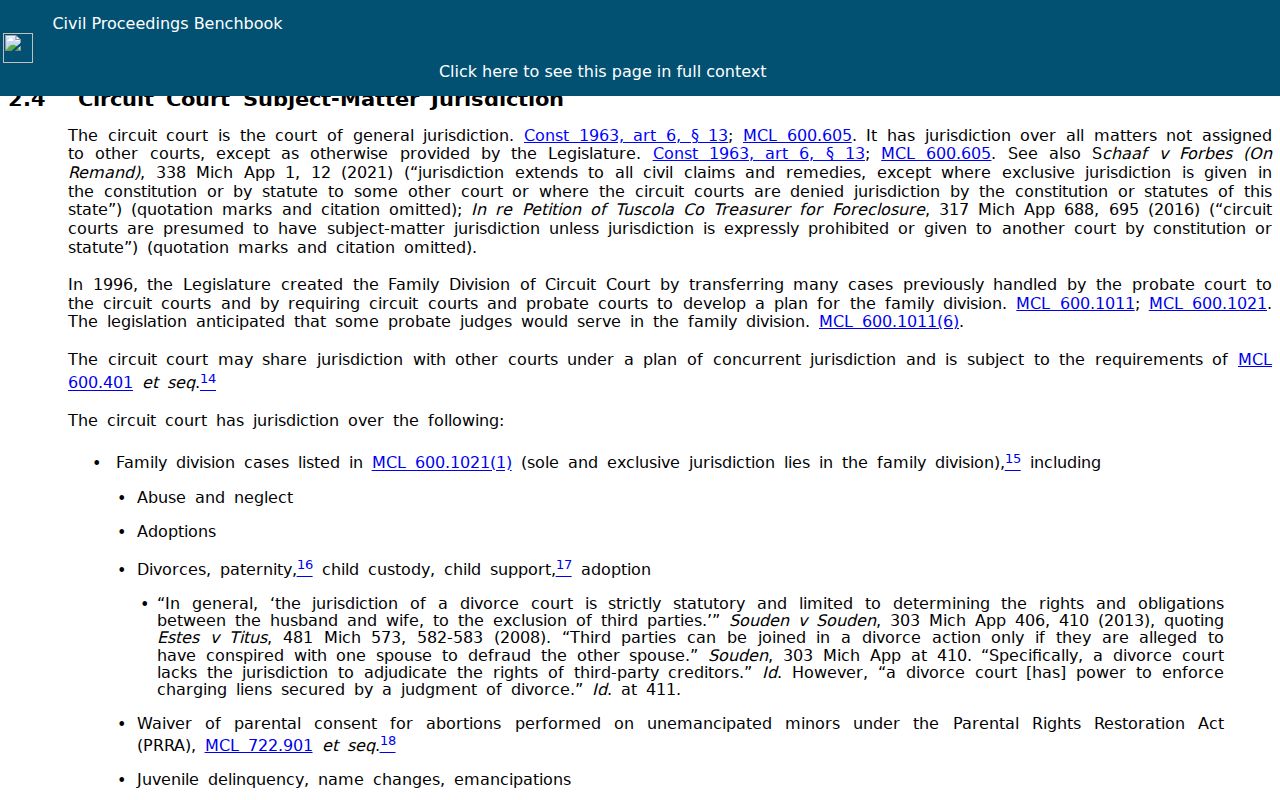
The same reference helps separate a circuit civil record from a 95B district civil one. Not every civil matter travels the same route, so match the claim to the right court before requesting files.
| Court | Iron County civil docket coverage | Record custodian |
|---|---|---|
| 95B District Court | Civil claims within its authority, civil infractions, and district proceedings | District Court Clerk |
| 41st Circuit Court | General-jurisdiction civil cases, family division, and circuit appeals | County Clerk, circuit function |
| Probate Court | Estates, trusts, guardianships, conservatorships, and statutory probate matters | Probate Registrar |
Inside an Iron County Civil Docket
A typical Iron County civil docket opens with a header. It names the court, case number, case type, filing date, status, and judge. If the case closed, it also carries a disposition date. The register of actions then runs in date order. It moves through the parties and lawyers, the complaint or petition, an answer, service, motions, responses, scheduling activity, hearing dates, orders, judgment, settlement, default, satisfaction, appeal, reopening, or an inactive date. Read filing language with care. A complaint, counterclaim, motion, or affidavit only records what a party alleged or requested. It proves nothing the court found. The items that answer a decided question are the order, the judgment, the verdict, or an exact disposition. A civil default can end in judgment. But the docket word "default" alone tells you no amount, facts, or relief. The judgment entry carries that.
| Case header | Court, case number, filing date, case type, judge, status, disposition date, and reopened or inactive fields where shown. |
|---|---|
| Parties and roles | Public party names, plaintiff and defendant roles, attorneys, and service or representation status. |
| Filings | Complaint, petition, answer, counterclaim, crossclaim, motion, response, proof of service, or public exhibit entry. |
| Settings and orders | Scheduling conference, hearing, mediation or settlement event, order, judgment, appeal, and reopening entry. |
| Outcome and finance | Exact disposition, costs, interest, garnishment, payment, satisfaction, or other public financial entry. |
Iron County Civil Record Custodians
Every Iron County civil record lives with a specific office. For a 41st Circuit case, that office is the Iron County Clerk/Register of Deeds. That office serves as clerk of the circuit court and keeps circuit civil, criminal, and divorce filings under court direction. A 95B civil request goes to the District Court Clerk instead. Probate requests go to the Probate Registrar. The courthouse is shared. Custody roles differ. Lead every request with the court name, never the building alone.
A written request should be specific. Give the court, case number, public party name, approximate filing year, and the exact record sought. Say whether you want inspection, an ordinary copy, or a certified copy. Add delivery contact information. A clerk can tell you whether an item is public, redacted, sealed, or available only for inspection. The clerk cannot interpret a claim's legal meaning. The office provides the record itself. The County Clerk's official page documents the circuit-clerk role behind an Iron County civil docket request.
A 95B civil case belongs to the District Court Clerk, not the circuit clerk's office.
County Clerk, Circuit Records
Suite 9, 2 South 6th Street, Crystal Falls, MI 49920
906-875-3221
95B District Court Clerk
Suite 5, 2 South 6th Street, Crystal Falls, MI 49920
906-875-0619
Civil Case Types on the Docket
What shows up on an Iron County civil docket depends on two things: the court and how the case was filed. District Court can carry civil claims within its authority. It also handles civil infractions and summary proceedings. Circuit Court can carry general civil claims above district authority. It also takes family matters and permitted appeals. Probate records take their own court route and may carry different privacy limits. When a MiCOURT result shows a category, that label is the safer one to use. City ordinance activity can be a district-court civil matter too. Caspian's code directs civil citations to Iron County District Court. Crystal Falls ordinance material sends certain municipal civil infractions to a district-court judge or magistrate. The local rule explains the subject. The court's record shows whether a matter was filed, heard, dismissed, or otherwise resolved.
- 95B civil claims within district-court authority
- 95B civil-infractions and local ordinance matters routed there
- 41st Circuit general civil proceedings
- 41st Circuit family division matters with applicable privacy limits
- Probate matters using the Probate Court route
Iron County City Ordinance Dockets
Iron County's four incorporated cities each keep records their own way. Ordinances, minutes, and administrative material sit with their city clerks and city records. A filed municipal civil infraction can still land on an Iron County 95B District Court docket. That split matters. An ordinance index is not a civil case search. The county payment page is not a docket database either. Use the city source for the rule itself. Use the court route for a citation, hearing, case history, or disposition. The split also helps when a search starts with a city name but the court result sits at the county level. Keep the citation number, ordinance section, case number, and date in one place. Search the district court in MiCOURT. Check Court Display for a public setting. Ask the District Court Clerk to confirm any missing or unclear filing. The four city profiles offer no standalone municipal docket portal. Note: A city administrative record can explain a local rule. The Iron County court record documents any filed judicial proceeding.
Iron County Civil Docket Settings
A civil setting is a date on the calendar, not a ruling. The public Michigan Court Display can show several fields for the Iron County civil docket. These include the selected date, the court or display, the time and room, the party name, and the case number. Pick the live local display, since the fields appear only where the county publishes them. Confirm anything that matters with the clerk before you rely on it. MiCOURT case history and Court Display do not always update at the same moment. A cancelled or continued hearing can linger in one place. The new setting may not show up in the other yet. Write down the selected date and the time you viewed it. Check nearby dates too. Then call the office that handles the matter before you drive to the courthouse. The county Trial Court directory lists the direct numbers for each department. If a call will not go through because of the county phone issue, send an email with a number where you can be reached.
Iron County Civil Judgment Terms
Some docket labels look bigger than they are. A single word like "judgment" can seem final. Yet the entry may only mark a step in the file. Read the Iron County civil docket as a chronology. Set the order, judgment, or exact disposition beside the filing that came before it. Public entries here run brief, and the court file still holds the controlling text.
- Complaint
- The pleading that begins a civil action and states allegations or requested relief.
- Default
- A procedural result when a party does not respond or appear as required; the later judgment controls the relief.
- Settlement
- A resolution entry that does not itself establish an admission or merits ruling.
- Satisfaction
- An entry showing that a judgment or obligation was paid or released.
- Reopened
- A closed case returned to active status through a later court event.
One caution comes from the 2023 district report, which lumps uncontested, default, and settled cases into a single statistics category. It cannot assign one legal outcome to each Iron County civil docket. In the same spirit, keep a payment or garnishment entry separate from the claim's merits and from the exact judgment.
Civil Docket Access Rules
Michigan Court Rule 8.119 generally allows inspection and copying of public court records, unless a statute, rule, or court order restricts an item. Public electronic access must shield personal identifiers. Sealed exhibits, financial account information, protected addresses, and confidential material can be unavailable or redacted. And a missing public document is not proof that a civil record fails to exist.
County FOIA covers county administrative records such as policies or budgets. It is no shortcut to a judicial case file. For a court docket, ask the court of record about inspection, an electronic copy, an ordinary copy, a redacted copy, or any review procedure. A formal certificate comes only from the clerk who maintains the record.
Public-record boundary: MCR 8.119 governs public judicial records. Michigan FOIA is the separate county-administrative route.
Iron County Civil Copy Requests
Before requesting a civil copy, confirm the court and the exact document or register entry needed. County Clerk routing applies to circuit records, District Court Clerk routing applies to 95B records, and Probate Registrar routing applies to probate. Requests can be made in person, by phone for routing, or in writing by email, fax, or mail with the case details, delivery preference, and certification request. Ask about a public terminal if local access is needed on site.
Michigan standards cite a general certified-copy reference of $1 per page plus a $10 certification fee, but local staff should confirm the current total. The county payment page lists code 5879 for circuit certified copies and code 1375 for district fines and costs. Neither code searches a civil docket. Use MiFILE’s available-courts directory to confirm its public listings for the 41st Circuit and 95B-2.
MiFILE’s official court directory is shown here as the source for the two Iron County court listings.
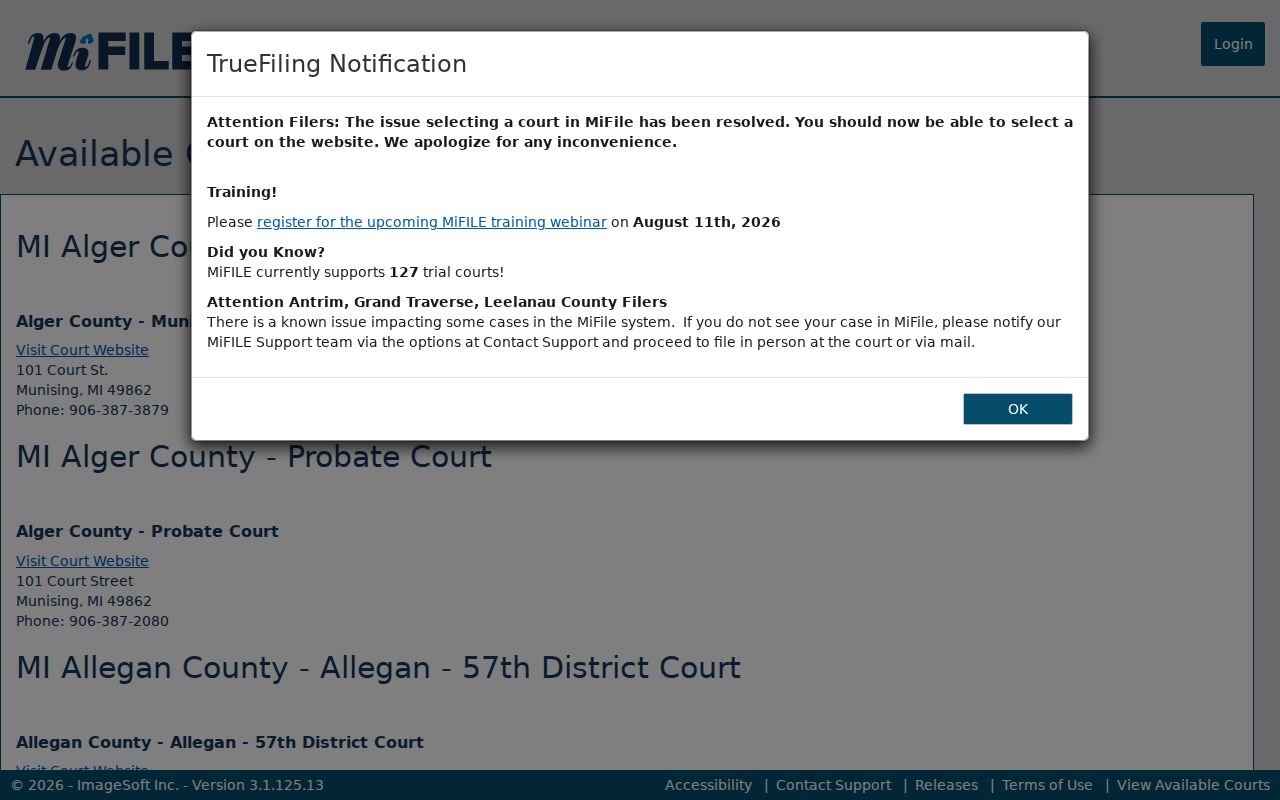
The directory confirms court locations for filing context, while MiCOURT and the responsible clerk remain the public routes for case history and records.
For a known civil case, Iron County Case Lookup can help confirm the court and public history before a targeted copy request.